
JetStream DR can be configured and deployed in several different ways, depending on the protection services required and the type of software-defined data center being protected:
- On-Premises Data Center to Cloud Object Store & Cloud Data Center (DRaaS)
- Recovery Site Located Independently of Object Store
- Simple Replication to Object Storage
- Cloud-Internal DR
On-Premises Data Center to Cloud Object Store & Cloud Data Center (DRaaS)
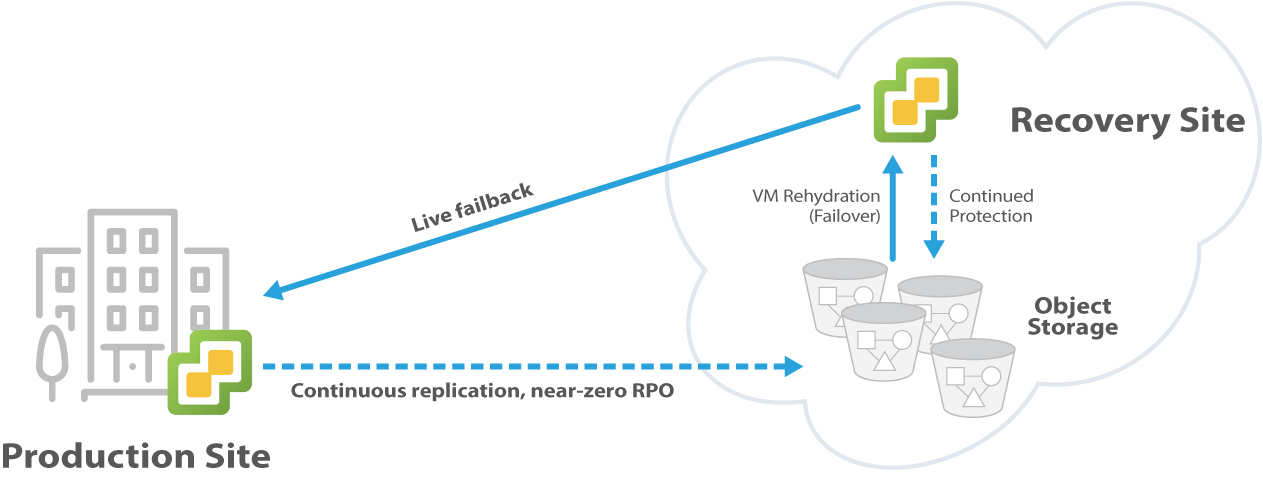
Overview
For organizations operating VMware-based on-premises data centers, ensuring that critical workloads can survive a site-level disruption—and resume operation rapidly in an alternative environment—is a foundational requirement of any mature IT strategy. JetStream DR addresses this need by enabling a fully cloud-integrated Disaster Recovery as a Service (DRaaS) model, combining the economics of cloud object storage with the compute power of a cloud-hosted VMware environment to deliver a resilient, cost-effective, and operationally simple DR solution.
Key Benefits of This Use Case
Eliminate the cost of a dedicated DR site. By leveraging cloud object storage and an on-demand cloud VMware environment, organizations avoid the capital expense of maintaining a fully provisioned secondary data center that sits idle under normal conditions.
Pay only for what you use. Cloud object storage is highly cost-efficient, and compute resources in the cloud recovery environment are only consumed during an actual failover or test event—making this model significantly more economical than traditional active-active or warm standby DR architectures.
No data loss, no service interruption. Continuous replication before, during, and after a failover event—combined with live failback—ensures that the organization’s data is always fully protected and that business operations are never unnecessarily disrupted.
Operational simplicity. The entire DR lifecycle—from initial configuration and ongoing monitoring, to failover, cloud operation, and failback—is managed through JetStream DR’s native vCenter plug-in, keeping operations simple and familiar for VMware administrators without requiring specialized DR expertise or dedicated DR management platforms.
Recovery Site Located Independently of Object Store
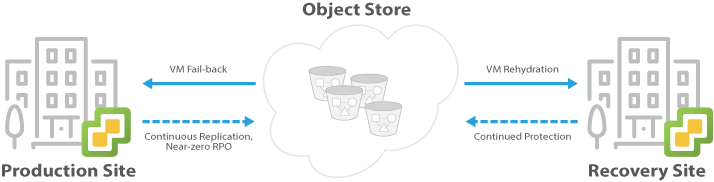
Overview
A defining strength of JetStream DR’s architecture is the deliberate decoupling of data storage from data recovery. Unlike many traditional DR solutions that require the replication target and the recovery compute environment to be co-located—or that tie organizations to a single vendor’s integrated stack—JetStream DR is designed to support deployment models where the object store and the recovery site exist as entirely separate, independently operated entities. This architectural flexibility opens up a wide range of service delivery options for managed service providers (MSPs), cloud service providers (CSPs), and enterprise IT teams alike, enabling them to construct DR solutions that are optimally tailored to their geographic, regulatory, commercial, and technical requirements.
Key Benefits of This Use Case
Architectural freedom. Organizations and service providers are not constrained to a single-vendor or single-location DR model. Each component of the DR infrastructure—storage, compute, and management—can be sourced and located independently based on cost, performance, compliance, or commercial considerations.
Cost optimization. By separating storage from compute, organizations can right-size each component independently. Low-cost object storage can be paired with appropriately scaled recovery compute that is only consumed when needed, avoiding the expense of maintaining co-located infrastructure that must serve both purposes simultaneously.
Multi-provider resilience. Distributing the object store and recovery site across different providers or facilities introduces an additional layer of resilience—reducing the risk that a single provider outage could simultaneously affect both data storage and recovery compute.
Regulatory and data sovereignty compliance. Independent placement of the object store and recovery site enables precise control over where data resides and where workloads recover, supporting compliance with a wide range of data residency and regulatory requirements.
Scalable managed service delivery. For MSPs and CSPs, this architecture enables the construction of flexible, multi-tenant DRaaS offerings that can be tailored to individual customer requirements without the need to redesign the underlying infrastructure for each engagement.
Simple Replication to Object Storage
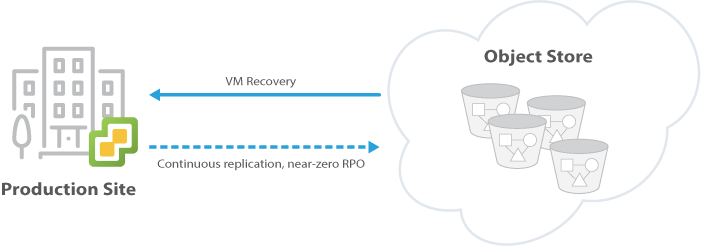
Overview
Not every organization’s disaster recovery strategy requires an immediately provisioned, always-available recovery compute environment. For many businesses, the priority is ensuring that a reliable, current, and geographically separate copy of their critical VM data exists at all times—one that can be drawn upon to restore operations whenever and wherever alternative compute resources become available. JetStream DR’s Simple Replication to Object Storage use case addresses precisely this need, delivering a streamlined, cost-efficient data protection model that prioritizes data durability and remote redundancy without the overhead of maintaining a dedicated recovery site. This configuration is an ideal fit for organizations seeking to modernize their data protection posture, reduce storage costs, and adhere to established data protection best practices—including the widely recommended 3-2-1 rule—while retaining the flexibility to define their recovery strategy independently of their replication infrastructure.
Key Benefits of This Use Case
Near-zero RPO without a dedicated recovery site. Continuous replication ensures the remote data copy is always current, minimizing potential data loss regardless of when a disruption occurs.
Significant cost savings. Eliminating the need for a standing recovery compute environment dramatically reduces the total cost of the data protection solution, while object storage pricing and JetStream DR’s data reduction capabilities keep ongoing storage costs low.
3-2-1 compliance made simple. JetStream DR provides the off-site, continuously updated copy of VM data that completes the 3-2-1 protection model without the complexity or cost of traditional off-site backup infrastructure.
Recovery flexibility and portability. Replicated data stored in standard object storage can be recovered into any compatible VMware environment, preserving the organization’s freedom to define its recovery approach based on circumstances at the time of need.
Scalable and future-proof. This configuration can serve as a stepping stone toward a more comprehensive DRaaS deployment, with a provisioned recovery site added when organizational requirements, risk appetite, or budget dictates—without requiring any changes to the underlying replication architecture.
Cloud-Internal DR
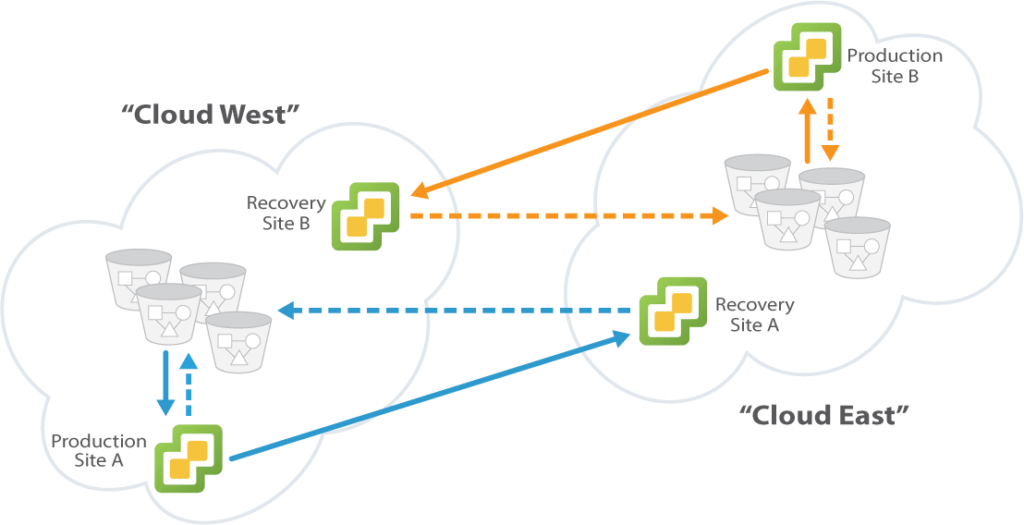
Overview
As cloud service providers (CSPs) continue to expand their infrastructure footprints across multiple data centers and geographic regions, the ability to deliver robust, internally managed disaster recovery capabilities for their hosted customers has become a critical differentiator. JetStream DR’s Cloud-Internal DR configuration enables CSPs to build and operate a fully self-contained DR service entirely within their own cloud infrastructure—protecting customer workloads hosted in one data center by continuously replicating their data to object storage in a separate facility, and recovering those workloads rapidly in the event of a disruption. This model gives cloud providers the tools to offer enterprise-grade DR guarantees to their customers without dependence on third-party recovery platforms or external storage services.
Key Benefits of This Use Case
Full self-containment. The entire DR lifecycle—replication, failover, recovery, and failback—is managed within the cloud provider’s own infrastructure, eliminating external dependencies and simplifying operations.
Bi-directional resilience. Mutual protection between data centers ensures that both facilities and their hosted workloads are continuously protected, with no single point of failure in the protection architecture.
Near-zero RPO and fast RTO. Continuous IO-level replication ensures that the most current copy of customer data is always available in the secondary object store, enabling rapid, low-data-loss recovery when needed.
Maximized infrastructure efficiency. Active-active data center utilization avoids the waste of dedicated standby capacity, improving the economics of the DR service for both the provider and its customers.
Competitive service differentiation. Embedded, provider-managed DR capabilities with defined resilience guarantees strengthen the CSP’s market position and increase customer stickiness by delivering a higher-value hosting proposition.